

Table of contents
The fifth edition of the State of Customer Experience report is based on a global survey of 5,811 consumers and 1,560 customer experience (CX) professionals and business leaders. Produced by Genesys, the report gives a picture of what customers actually go through and what organizations think they are delivering.
This year, it puts the spotlight on how consumer expectations are shifting in the age of agentic AI. Agentic AI is redefining what customers expect in terms of speed, personalization and efficiency. In two years, AI has become an essential technology for businesses. It isn’t just changing how companies deliver service. It’s changing what customers consider acceptable. And the gap is widening. European consumers add one more requirement: trust.
Customer service quality defines the brand
More than half of customers would rather do anything else than contact a customer service team. And 1 in 2 CX leaders say the same. Customer service has to be simple, fast and contextual so the customer doesn’t feel like they’re caught in a complicated journey.
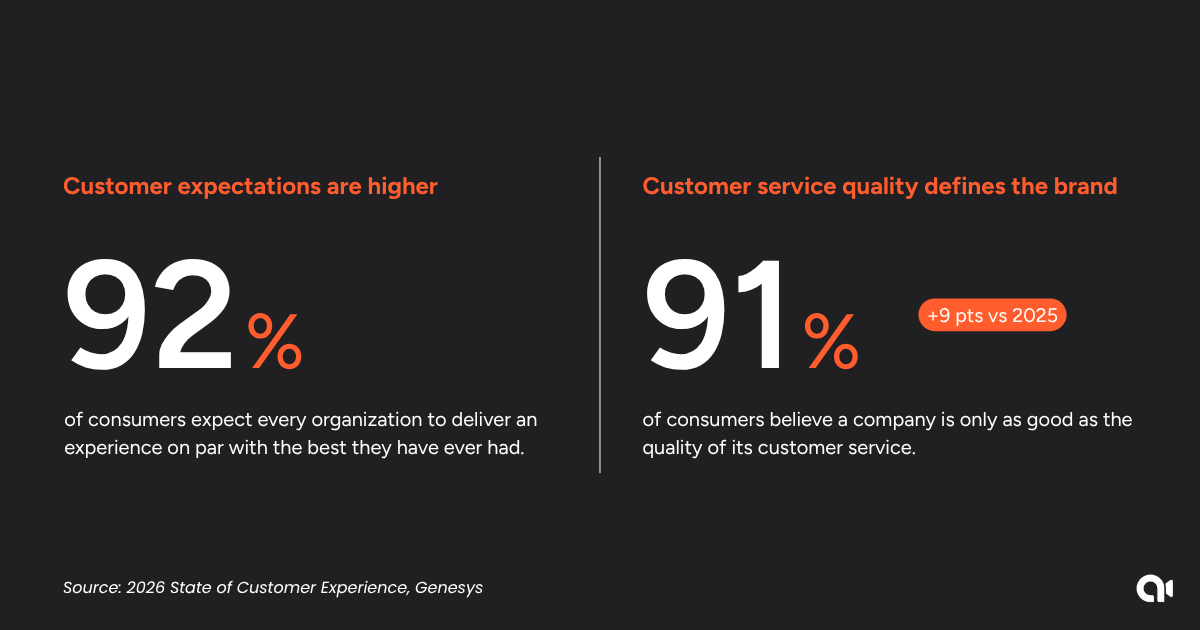
Because at the same time, customer service has never weighed so heavily on brand image. For 91% of customers, a company is only as good as the quality of its customer service. That’s nine points higher than in 2025.
Even the yardsticks have changed. 92% of customers expect every company to deliver an experience on par with the best one they have ever had, in any industry. A bank is no longer compared with other banks, but with the best interaction the customer has experienced, whatever the sector.
- 47% of consumers would switch to another brand after only two or three bad interactions, even with a brand they like
- 85% have already cut their spending with a brand, or stopped buying from it, after a bad customer service experience (43% cut back, 42% stopped buying)
And fast handling doesn’t make up for a bad experience. 94% of customers place as much importance on service efficiency as on empathy during the exchange. 57% say they would definitely or probably turn to a competitor after feeling a lack of empathy.
AI raises expectations, but patience is wearing thin
According to the Genesys report, consumers aren’t rejecting AI, quite the opposite. More than half use it at least once a week in their personal (52%) and professional (53%) lives. 1 in 2 has a more positive view of AI-driven customer experience than they did two years ago.
- 76% of customers think AI will improve the quality and speed of customer service within two to three years
- 75% believe it will improve personalization
- 76% say that who resolves the issue, human or AI, matters little as long as the resolution is fast and complete
But the more AI improves the quality of experiences, the more demanding customers become and the less they accept errors and friction. 84% of consumers give a virtual agent up to three attempts to solve their problem. Fewer than 20% are willing to give it more.
Self-service is taking hold in the customer journey
AI isn’t just changing the way customers interact with a brand. It also lets them resolve their own requests.
- 65% of customers say virtual agents make it easier for them to solve their problems on their own
- 78% think companies are making progress in putting effective self-service in place
On the company side, 92% of CX leaders consider virtual agents effective at helping customers resolve their request.
But self-service doesn’t replace people. Companies have to let the customer choose the level of help they need. Effective AI knows how to resolve, but it also know how to recognize its limits and escalate at the right moment.
Escalating to an agent is a key moment for trust
95% of customers say it matters that a company can take them from one channel to the next while keeping the information they have already given. Yet 52% of companies still don’t pass on to human agents the information collected earlier in the interaction.
- 26% have had to repeat to a human agent what they had already explained to a chatbot
- 33% have had to repeat that same information to several human agents
- 20% say having to repeat themselves irritates them enough to make them want to scream or drop the brand for good
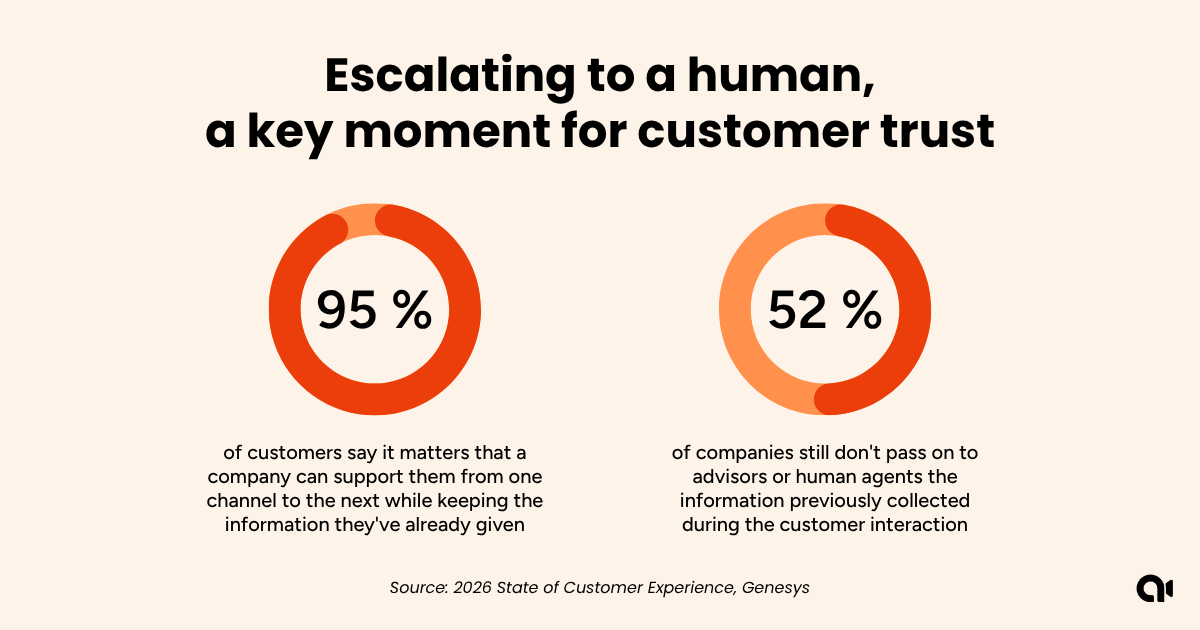
Handing off information is the real breaking point. What disappoints the customer isn’t that AI failed to solve the problem, it’s the time lost because the context was never passed on to the human agent.
Humanize your escalations
When a request moves from a virtual agent to an advisor, Apizee’s remote visual support solution makes it possible to see the situation immediately, without making the customer repeat themselves.
Get a demoAgentic AI for a better customer experience
Agentic AI isn’t just autonomous AI. It can understand a situation, access context and act inside the company’s systems. Today, agentic AI sits at the heart of organizations’ customer experience strategies.
- 40% of CX organizations already use agentic AI
- 86% of CX leaders expect AI to be part of every customer interaction by 2029
- 82% believe autonomous AI agents will orchestrate the customer experience within the next three years
On the customer side, 46% are comfortable with AI making decisions on their behalf if it speeds up the handling and resolution of their request.
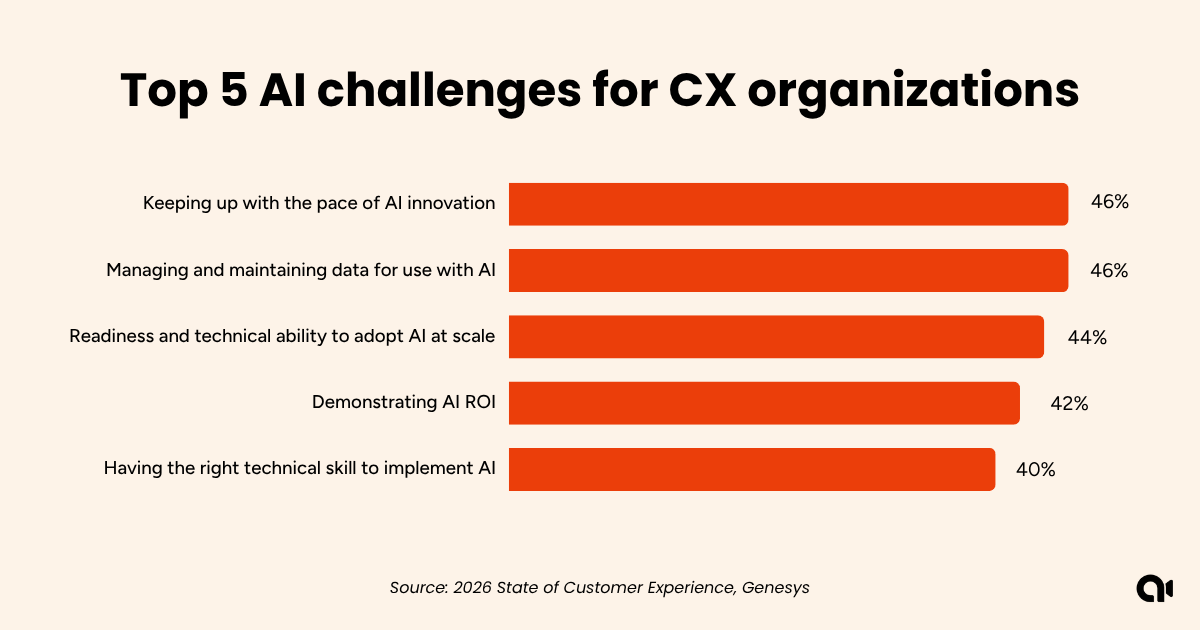
For the year ahead, CX leaders plan to devote an average of 30% of their customer service budget to AI-driven customer experience technologies. Yet 42% still cite proving value or return on investment as a major challenge. Only 27% make it a strategic priority. The sticking point isn’t adoption, it’s scaling.
No orchestrated experience without unified data
Data is the foundation of agentic AI. Right now, managing AI-ready data remains organizations’ top technology challenge, cited by 46% of CX leaders.
Orchestrating the customer journey means knowing who the customer is, understanding what they need, knowing about previous interactions and determining the next action. When that information stays scattered across disconnected systems, AI can improve an isolated interaction but can’t make the whole journey seamless. So organizations have to work on how their data and systems connect to each other.
That said, CX leaders aren’t underestimating the issue. 91% believe their organization will be able to orchestrate the customer experience end to end within three years, and 73% consider a platform that can integrate with the company’s other systems essential to their CX goals.
Transparency: the expectation companies underestimate
94% of customers believe they have the right to know when they are interacting with an AI, and 69% think companies should say so clearly.
Leaders see it the same way, with 74% viewing responsible AI deployment as a critical technology initiative. Yet only 26% make it a major priority for the next three years. That’s a risky call when 73% of CX leaders expect that, within three years, customers will no longer be able to tell a human agent from an AI agent. Transparency then becomes a deliberate choice, one to build in from the design stage.
The new role of humans in customer service
One of the biggest irritants in customer service is not being able to reach a human. It causes so much frustration that customers say they no longer want to deal with the company in the future.
On the organization side:
- 91% believe human agents will continue to play an essential role in the customer experience over the next three years
- 90% expect the interactions handled by humans to be complex situations or emotionally charged ones
- 92% believe humans should keep the role of final decision-maker in AI-driven interactions
Yes, AI absorbs the volume and the simple requests. But that means the human interactions left over are harder, more technical and more emotionally loaded. These interactions call for better tools, not fewer advisors. CX leaders are in fact already anticipating this shift: 88% expect contact center jobs to be deeply transformed by AI within three years, and 87% expect an integrated human-AI working model to become reality. The question is no longer AI or human, but who handles what, when and with what resources.
Resolve complex problems quickly
Your agents are handling increasingly complex requests. See how Apizee’s visual engagement solutions give them the means to resolve issues remotely.
Contact usEurope: the challenge isn’t AI adoption, it’s execution
European consumers are noticeably more reserved about AI. They aren’t rejecting it, but they want proof. A European company will have to rely on trust, transparency and concrete proof of AI’s value to win its customers over.
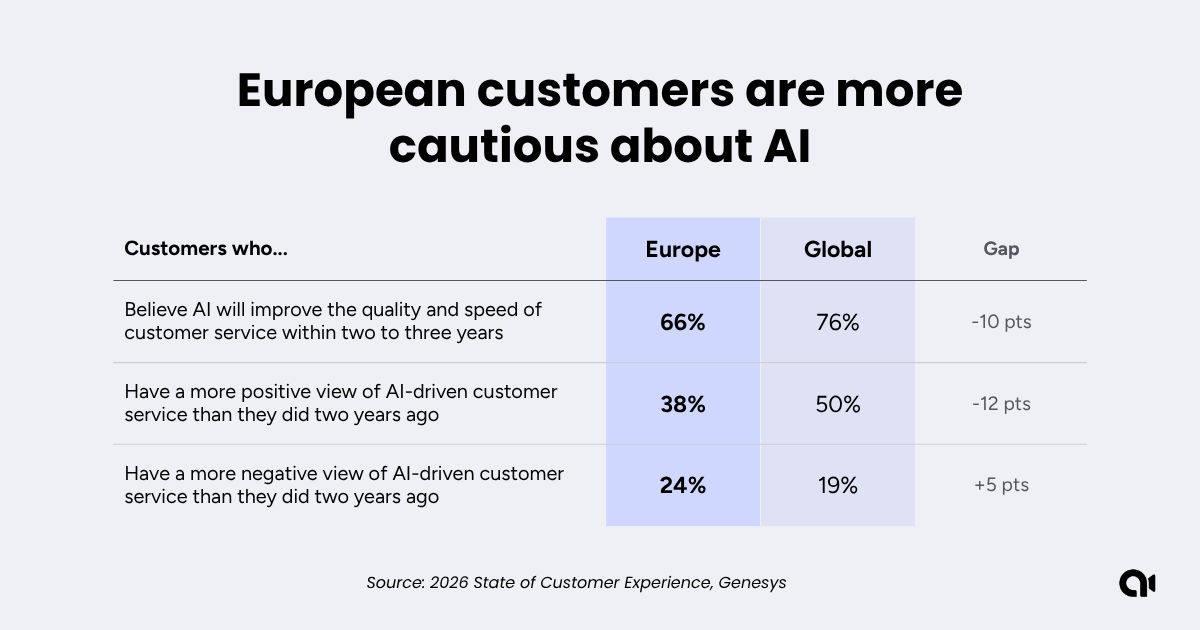
European companies invest almost as much in AI as the global average (29% of their CX budget versus 30%). But their operational capabilities lag behind: only 14% of European CX leaders report significantly reducing customer effort, versus 24% globally. And 25% believe they offer extremely personalized service, versus 35% worldwide.
On the other hand, European CX leaders are betting more on the relationship. 29% aim their optimization efforts at loyalty and empathy, more than any other region and well above the global average of 18%. In France, that figure climbs to 43%, 37% in Ireland and 31% in Germany.
The main challenge for European companies is their agility to turn investment into orchestrated experiences. As long as an agent has to go looking for customer context themselves, AI can’t guarantee a seamless customer journey. The task for the years ahead will be to modernize their platforms to move AI forward, while keeping the transparency and human control needed to deliver more personalized, more empathetic experiences.
5 tips to be ready for the future of customer experience
- Unify the platform before the experience. As long as channels, data and workflows live in separate systems, every new tool improves one interaction without improving the journey as a whole.
- Move from automation to orchestration. Agentic AI isn’t only there to handle a request faster. It coordinates data, systems and teams across the entire journey. That’s what makes it possible to guarantee efficiency without sacrificing the relationship.
- Design an omnichannel journey. Customers don’t grade channels one by one. What they remember is how smooth the whole thing was and how much effort they were asked to put in to reach a resolution.
- Build a human-AI pairing. Define what AI does, what calls for human judgment and when escalation happens. Then give human agents the tools and training to handle the interactions that are now more complex.
- Make responsible AI a design choice. Be clear about when AI is involved, keep humans in charge of decisions and set boundaries on what AI agents can do. In a cautious European market, transparency is a selling point.
Conclusion
Customers expect faster, simpler, more personalized interactions. They are increasingly open to AI, but their tolerance for friction is dropping: repeating information or switching channels without keeping the history can quickly damage the relationship and the company’s image.
For organizations, the challenge is no longer simply to adopt AI. They have to embed it in a seamless, unified experience. How effective agentic AI proves to be will depend on the foundations underneath it: accessible data, connected systems, consistent workflows, governance, and collaboration between humans and AI. The companies that stand out won’t be the ones that deployed the most AI, but the ones that integrated it best across their whole customer journey.
To learn more, download the full 2026 State of Customer Experience report.
Want to strengthen the moments when your agents really make the difference? Talk to an Apizee expert today.
![[CX Industry Voices] Interview with Banu Cinar](/scripts/files/6ad86dc2bb9b70.81259781/banu-cinar.png)