
Table of contents
Could video calls become the missing link between digital efficiency and human customer service?
Video calls are becoming a more important part of customer service, especially in situations where customers need to show an issue rather than explain it. From troubleshooting and onboarding to claims and high-trust interactions, video gives support teams more context and makes it easier to deliver a faster, more personal experience.
While adoption is still relatively low compared to other service channels, the data points to growing demand, strong satisfaction, and clear CX benefits when video is used in the right moments.
Below, we break down the key stats on video calls in customer service, from usage and human interaction to customer satisfaction, customer effort, and resolution time.
How many customers use video calls in customer service
Video support is still an emerging customer service channel, but demand is already outpacing adoption. While relatively few consumers have used live video support so far, many more say they would consider it, especially when they need help resolving an issue, requesting a refund, or getting more personalized support.
- 24% of consumers say they have used live video support.
- 54% would consider live video for help with an issue/problem.
- 50% would consider live video for a refund interaction.
- 31% say they would consider using video support in the future.
- 75% of consumers still prefer talking to a real human in person or over the phone for support, which suggests video works best as a human digital channel, not a replacement for people.
- 82% of service professionals say customer expectations are higher than they used to be, which helps explain why richer support formats like video are gaining attention.
- 79% of customers expect consistent interactions across departments, while 56% say they often have to repeat or re-explain information to different reps. That makes channels that preserve context and reduce re-explaining more valuable.
Why businesses use video calls in customer service
The biggest advantage of video support is simple. It helps customers and agents see the same thing at the same time. Instead of describing a problem through chat or voice alone, customers can show what is happening, which makes interactions clearer, more personal, and often easier to resolve.
- The main benefit of video is that customers can show the issue instead of only describing it.
- Zoom’s consumer research highlights visual explanation as one of the key perceived advantages of live video support.
- Forrester says live video chat for customer service can increase customer satisfaction, decrease dispute-resolution time, and drive ROI for both B2B and B2C firms.
- Video is especially relevant when visual context matters, including troubleshooting, onboarding, product setup, claims, field service, and high-trust conversations.
- Because 75% of consumers still prefer human support, video works best when it adds a human layer to digital service rather than trying to replace it.
In broader CX, 78% of consumers would consider switching brands after a single poor interaction, which means channels that solve problems more clearly and confidently can have a real retention impact.
Why human interaction still matters in customer service
As automation and AI become more common in customer service, the demand for human support is not going away. In many cases, it becomes even more important. When an issue is complex, stressful, or trust-sensitive, customers still want empathy, reassurance, and a clear path to a real person.
- 75% of customers would rather interact with a human for customer service, especially for more complex or sensitive issues.
- 81% would rather wait to speak with a human than get instant AI support.
- 52% of customer service professionals say customers seek out human agents for their empathy and understanding.
- Gartner predicts that by 2029, 80% of customer service issues will be resolved without human intervention, which makes the human escalation path more important, not less.
- Gartner also reports that 30% of customers use three or more channels to resolve a single issue, showing how easily customers can get stuck in high-effort service loops.
Apizee argues that a visible talk to a human option can reduce anxiety and restore trust, even when customers do not end up using it.
How video calls improve customer experience metrics
Video support does more than make interactions feel more personal. It can also improve the customer experience metrics that matter most, from satisfaction and first contact resolution to customer effort, handling time, and loyalty.
The biggest reason is practical: when agents can see the issue, they can understand it faster and resolve it more effectively.
Video calls can improve customer satisfaction (CSAT)
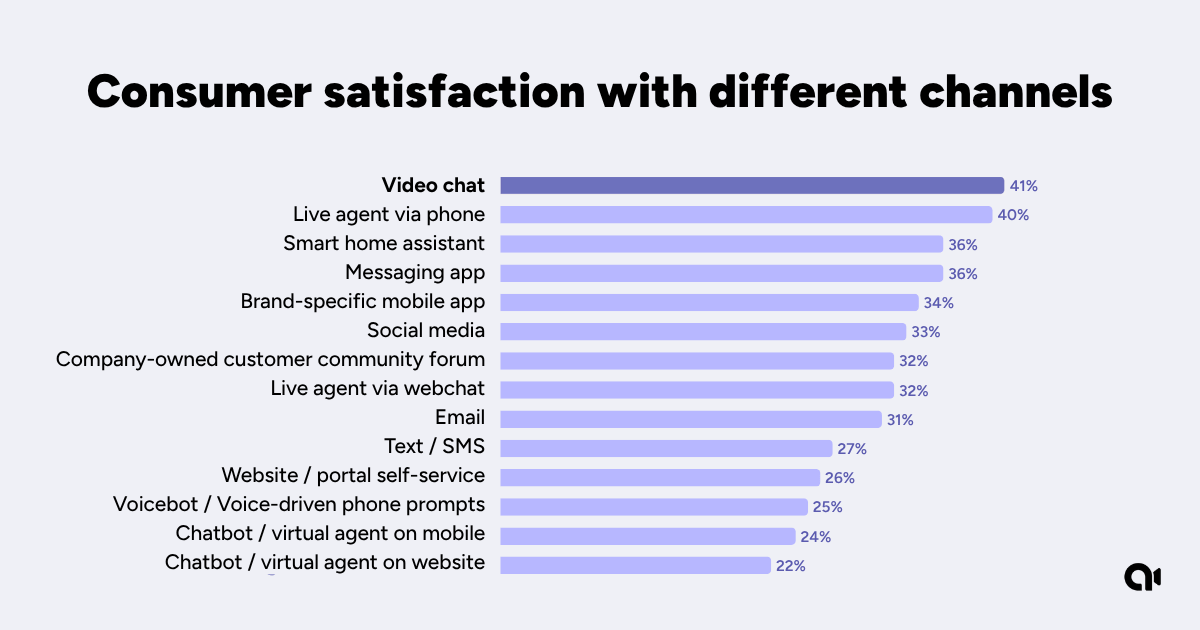
- 41% of consumers said they were extremely satisfied with video chat-based service interactions.
- That compares with 40% who said the same about phone-based interactions, suggesting video can perform at least as well as traditional voice in the right scenarios.
- Forrester also says live video chat can increase customer satisfaction.
- The case for video is operational: when agents can see the product, setup, damage, or environment, they can diagnose more accurately and reduce repeat contacts.
- This makes video especially useful for troubleshooting-heavy service journeys where visual context improves understanding from the first interaction.
- 56% of customers say they often have to repeat or re-explain information to different representatives.
- Video can reduce that effort in visually complex cases because customers can demonstrate the issue directly rather than describe it repeatedly.
- Forrester says live video chat can decrease dispute-resolution time.
- Apizee cites cases where video calls reduced average handling time by 34% to 42%.
- Apizee also cites examples where video support helped improve NPS from +63 to +78.
- 78% of consumers would consider switching brands after one poor interaction.
- Brands delivering strong CX see 86% of customers likely to return to purchase and 81% likely to recommend the brand.
- Video is not a loyalty lever by itself, but it can protect loyalty in the moments that most shape trust, reassurance, and resolution confidence.
Video calls can improve first contact resolution (FCR)
- The case for video is operational: when agents can see the product, setup, damage, or environment, they can diagnose more accurately and reduce repeat contacts.
- This makes video especially useful for troubleshooting-heavy service journeys where visual context improves understanding from the first interaction.
Video calls can reduce customer effort
- 56% of customers say they often have to repeat or re-explain information to different representatives.
- Video can reduce that effort in visually complex cases because customers can demonstrate the issue directly rather than describe it repeatedly.
Video calls can shorten resolution time
- Forrester says live video chat can decrease dispute-resolution time.
- Apizee cites cases where video calls reduced average handling time by 34% to 42%.
- Apizee also cites examples where video support helped improve NPS from +63 to +78.
Video calls can help protect loyalty and retention
- 78% of consumers would consider switching brands after one poor interaction.
- Brands delivering strong CX see 86% of customers likely to return to purchase and 81% likely to recommend the brand.
- Video is not a loyalty lever by itself, but it can protect loyalty in the moments that most shape trust, reassurance, and resolution confidence.
Why the stats support video calls in customer service
Video calls are still an emerging customer service channel, but the data suggests they can deliver real value when used in the right moments. They help customers show problems more clearly, give agents more context, and add a human layer to digital support. That makes them especially relevant for complex, high-trust, or visually driven interactions where traditional channels fall short. As customer expectations continue to rise, video support has the potential to improve both the customer experience and the metrics behind it.
If you’d like to see how video support could fit into your own customer journey, try Apizee and explore how live video, visual assistance, and human escalation can help you deliver faster, more effective support.
Source
- Zoom, "Survey: Consumers expect more from customer support"
- Forrester, "Now You See Me — Video Chat Improves The Customer Experience"
- Five9, "New Five9 Study Finds 75% of Consumers Prefer Talking to a Real Human for Customer Service"
- Salesforce, "Latest Customer Service Statistics To Move Your Business Forward"
- Salesforce, "What Are Customer Expectations?"
- Apizee, "Why Speaking to a Human Still Matters in Customer Service"
- Apizee, "40+ Customer Experience Statistics for 2026"
- JMR Global, "The State of Customer Experience"
- Verint, "New Study Reveals 2025 as the Year AI-Powered CX Delivers Value"
Go further
Ready to transform your customer support? Get started with Apizee and bring real-time visual interactions directly into your service experience.
Get a demo