Table of contents
Understanding what customers say is not always enough to resolve complex issues. In many support situations, the real challenge lies in understanding what customers think, feel, and experience throughout their journey. That’s why customer service teams increasingly rely on structured frameworks that help them step into the customer’s perspective.
Empathy Mapping is one such framework. It helps customer service teams visualize customer thoughts, emotions, and behaviors to deliver more human, effective support. In this article, we’ll explore how empathy mapping can be used in customer service, how to apply it in real interactions, and how visual tools can strengthen its impact.
What Is Empathy Mapping in Customer Service?
Empathy Mapping is a customer-centric framework used to better understand customer experiences by capturing what customers say, think, do, and feel. The concept was popularized by Dave Gray, founder of XPLANE, as a way for teams to build shared understanding and empathy around user needs.
In customer service, empathy mapping helps agents and teams move beyond surface-level issues and uncover the emotional drivers behind customer behavior. Rather than reacting only to the stated problem, agents can anticipate concerns, adjust their communication style, and deliver more personalized support.
For organizations looking to learn how frameworks can improve customer service, empathy mapping provides a powerful foundation for designing more thoughtful and emotionally intelligent interactions.
How to Use Empathy Mapping for Better Customer Service
Applying empathy mapping in customer service involves capturing insights before, during, or after customer interactions—either at the individual case level or across common customer scenarios.
Agents and teams typically focus on four key areas:
What the Customer Says
Direct quotes, complaints, or questions shared during interactions.
What the Customer Thinks
Concerns, doubts, or expectations that may not be explicitly stated.
What the Customer Does
Actions taken by the customer, such as repeated contact attempts or workarounds.
What the Customer Feels
Emotions driving the interaction, including frustration, anxiety, or confidence.
By organizing insights this way, customer service teams can respond with greater empathy, tailor solutions more effectively, and reduce friction across touchpoints.
Empathy Mapping Template for Customer Service Teams
A simple empathy mapping template can be used by customer service teams to standardize how customer insights are captured and shared.
A typical template includes:
- Customer profile or scenario
- Say / Think / Do / Feel quadrants
- Pain points and motivations
- Opportunities for improved support
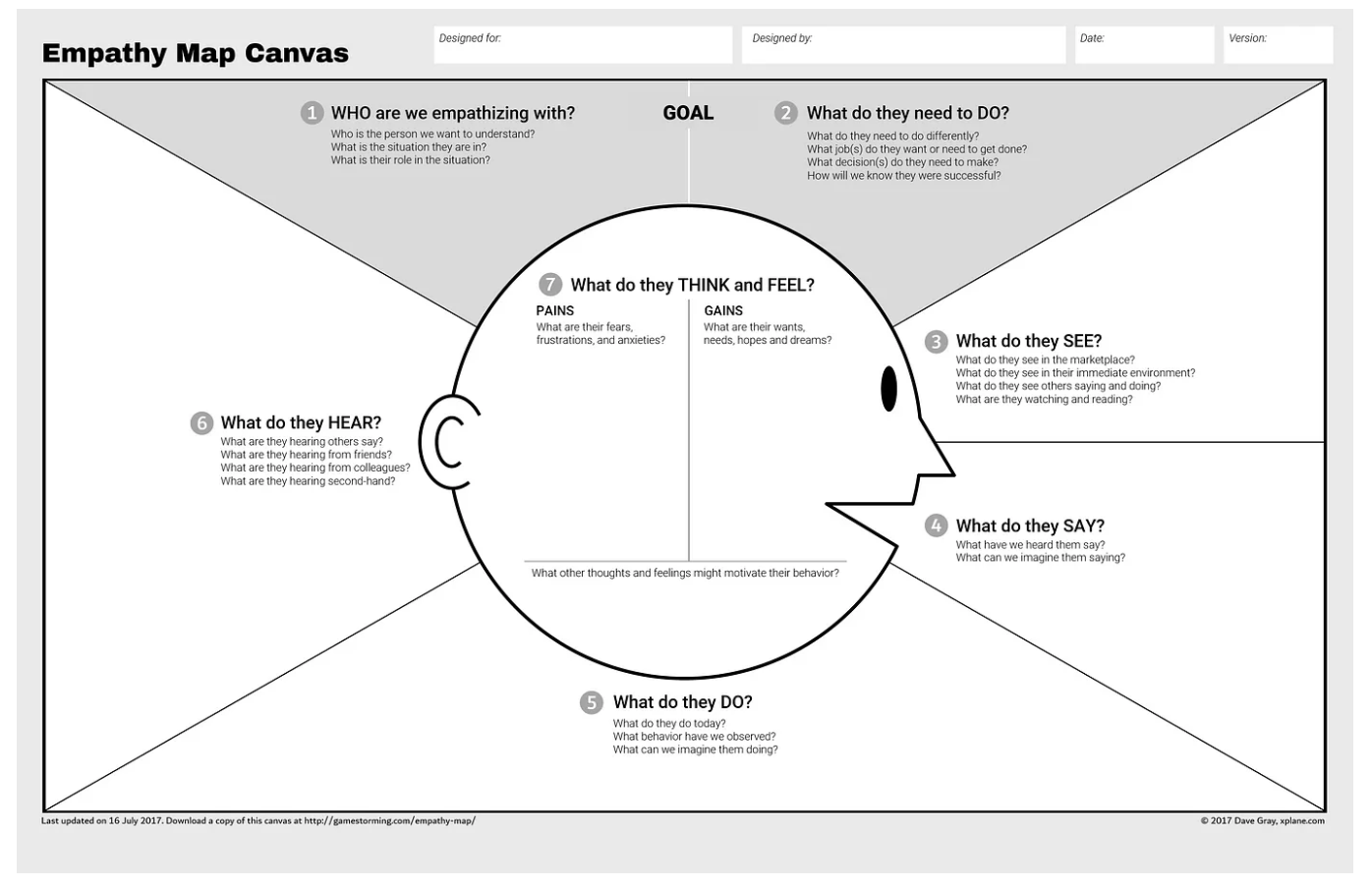
Empathy mapping templates are especially useful during training, retrospectives, escalation reviews, or service design workshops. They help teams align around the customer’s perspective and identify gaps between customer expectations and service delivery.
Using a consistent template also makes empathy mapping scalable across teams and channels.
Using Video Calls and Screen Sharing to Strengthen Empathy Mapping
Empathy mapping becomes even more powerful when combined with video calls and screen sharing, where agents can observe customer behavior and emotional cues in real time.
With Apizee, customer service teams can use video interactions to better understand what customers are experiencing—how they navigate interfaces, where they hesitate, and what causes frustration. Screen sharing allows agents to see the customer’s environment directly, making it easier to map what the customer does and feels, not just what they say.
Visual engagement enriches empathy maps with real-world context, leading to more accurate insights and more human customer service interactions.
Conclusion
Empathy mapping helps customer service teams shift from problem-focused support to customer-focused understanding. By visualizing customer thoughts, actions, and emotions, teams can deliver more personalized, effective, and emotionally intelligent service.
Go further : 30 Science-Based Empathy Statements for Customer Service and Why They Work