
Table of contents
The safety and wellbeing of social housing tenants has become a pressing issue in the UK following several tragic cases of health hazards in rented properties. When serious health risks arise over housing conditions, swift action and proper documentation are essential to protect tenants and ensure landlord accountability.
In October 2025, Awaab’s Law came into force, introducing a new legal framework that fundamentally reforms how social landlords must respond to reports of damp, mould and other housing hazards. The law introduces strict timeframes for investigating and fixing these dangerous conditions.
In this article, we'll explore the key requirements of Awaab’s Law and examine in detail what this new regulation means for social housing landlords, tenants, and the inspection process.
What is Awaab's Law?
Awaab's Law is a piece of legislation enacted as part of the Social Housing (Regulation) Act 2023, which came into force on 27 October 2025.
It's named after Awaab Ishak, a two-year-old boy who tragically died in 2020 from prolonged exposure to mould in his family's social housing flat in Rochdale.
The law establishes mandatory timeframes for social landlords to respond to tenant complaints about health hazards, particularly damp and mould.
When Does Awaab's Law Apply?
Awaab's Law is particularly relevant in several situations:
- For serious health hazards including damp, mould, and moisture problems that can affect respiratory health;
- When emergency repairs are needed due to an immediate risk to tenant safety;
- In cases where previous complaints have not been adequately addressed;
- For properties where condensation, ventilation or structural issues create ongoing problems.
The legislation represents a crucial step before disputes escalate to legal proceedings or regulatory intervention, and helps prevent tragic outcomes like Awaab's case.
How Apizee can help you
Use Apizee video calls to meet the timelines imposed by the Awaab's Law and address issues quickly and effectively.
Get a demoWhat are Awaab’s Law requirements for social landlords?
Awaab's Law is based on the principle of rapid response and accountability. It aims to ensure objective and timely assessments of housing conditions while protecting tenant health and safety across all of England's social rented homes.
- Emergency health and safety hazards must be fixed within 24 hours of being reported.
- For significant damp and mould, investigation must be completed within 10 working days of notification and properties must be made safe within 5 working days after investigation.
- Findings must be communicated to tenants in writing within 3 working days of inspection.
For all cases:
- Landlords must consider tenant circumstances that could increase risk (young children, elderly people, or those with disabilities or health conditions)
- Alternative accommodation must be provided at the landlord's expense if homes cannot be made safe within required timeframes
When does Awaab’s Law come into force?
The first phase of Awaab's Law, which came into force on 27 October 2025, applies to two specific categories:
- Emergency health and safety hazards that pose immediate risk to tenant safety
- Significant damp and mould
Future phases will expand coverage :
Phase 2 (2026) will expand protections to address extreme cold and heat exposure; fall risks in bathrooms, on flat surfaces, stairs, and between levels; structural failures and explosions; fire and electrical hazards; and domestic hygiene, personal hygiene, and food safety risks.
Phase 3 (2027) will cover all remaining hazards under the Housing Health and Safety Rating System, except overcrowding, where they present a significant risk of harm.
The Challenge of Meeting Awaab's Law Timeframes
The strict deadlines imposed by Awaab's Law present significant operational challenges for social landlords:
- Ultra-tight timeframes. Having only a few days to investigate and fix emergency hazards leaves minimal room for traditional scheduling processes, particularly when coordinating between inspection teams, contractors, and tenants. Arranging site visits can take days or even weeks—making compliance nearly impossible using conventional methods, especially when managing hundreds of properties simultaneously.
- Resource constraints. With limited inspection staff and high case volumes, many housing associations struggle to meet investigation and remediation deadlines, particularly during peak complaint periods or when handling complex cases that require specialist assessments.
- Rigorous documentation standards. Requirements to submit written summaries, keep tenants updated throughout the process, and maintain accurate records of all engagement, investigations and communications demand robust knowledge management systems to remain compliant.
- Legal consequences. Failure to comply can result in court action, enforcement orders, compensation payments, legal costs, and loss of rental income if homes are deemed uninhabitable. While landlords may have a defence if they've taken "all reasonable steps" to comply, proving this requires comprehensive documentation. The maximum fine for related electrical safety non-compliance has increased from £30,000 to £40,000.
- Alternative accommodation obligations. If safety work cannot be completed within specified timeframes, landlords must secure and fund suitable alternative accommodation for affected households—adding both complexity and significant cost to the compliance process.
These practical barriers can prevent landlords from meeting their legal obligations under Awaab's Law, potentially exposing them to significant penalties and, more importantly, leaving tenants in unsafe conditions.
How to Use Remote Visual Inspection to Meet Awaab’s Law Requirements
To meet the strict obligations mandated by Awaab's Law, social landlords can turn to remote visual inspection as a complement to traditional site visits.
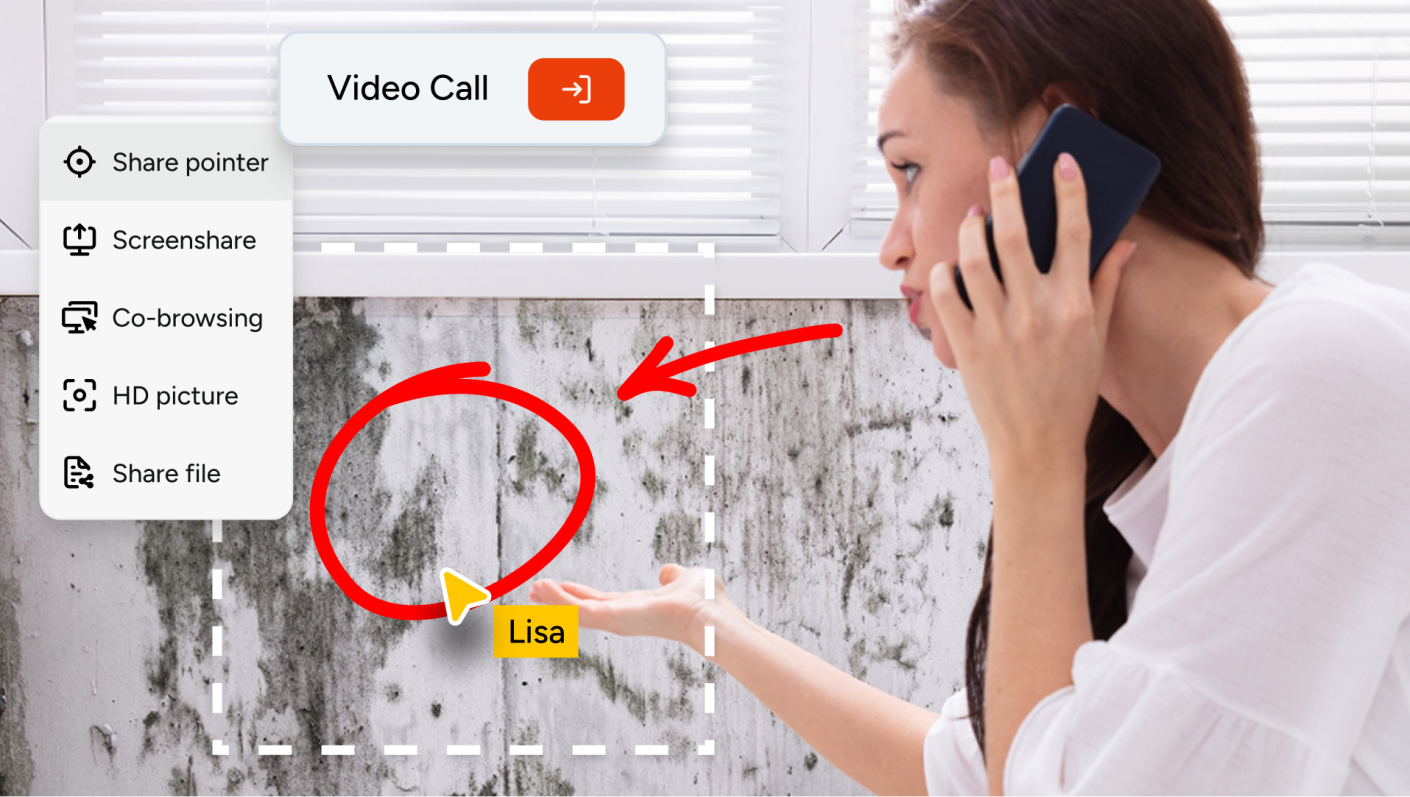
Remote visual inspection, or remote video inspection, is a method that allows property inspections to be carried out without a physical visit. Using a smartphone, a tenant or on-site operative shares a live video feed with a qualified inspector.
How Apizee’s Remote Visual Inspection Works
The remote visual inspection process is straightforward, delivering fast, effective assessments while maintaining the quality and thoroughness of traditional inspections. Here’s how it works:
Tenant Reports an Issue
When a tenant contacts their landlord about damp, mould or another hazard, the housing team logs the complaint and immediately schedules a video call for the same day or next day.
The Remote Visual Inspection
At the agreed time, the inspector connects with the tenant via secure live video, which allows:
- Visually inspect affected areas in real-time, with the tenant's phone or tablet serving as the inspector's eyes
- Assess the severity and extent of damp, mould, leaks or structural issues
- Capture timestamped photos and video evidence and automatically saved to the case file
Assessment and Decision
Based on the remote inspection, the housing officer makes an informed decision:
- Emergency repair needed: Complete investigation and safety work within 24 hours
- Serious hazard: Investigate within 10 days, make safe within 5 days after investigation, provide written summary within 3 days
- Routine maintenance: Add to regular work queue
- Monitoring required: Schedule follow-up inspection
- No action needed: Provide guidance or reassurance to tenant
Documentation and Compliance
The expert then generates a comprehensive inspection report including date and time of inspection, visual evidence (photos and videos), inspector's notes and assessment, and action taken and repair scheduled. This creates the audit trail needed to demonstrate Awaab's Law compliance to regulators.
All of this can happen without dispatching someone to the property, dramatically reducing response times.
The Benefits of Remote Visual Inspection
Remote video inspection revolutionizes housing management by offering an improved tenant experience and an optimized compliance process. Here are the key benefits for meeting Awaab's Law requirements:
- Speed and compliance: Video call enables housing teams to meet the 10-day investigation requirement easily, often completing assessments the same day. Tenants benefit from faster responses and quicker resolution of their concerns.
- Productivity and cost efficiency: Fewer site visits mean better resource allocation and the ability to handle more cases per day. By reducing travel time and expenses, landlords can redirect resources toward actual repairs while also reducing their carbon footprint.
- Evidence and accountability: Every remote inspection creates a timestamped, documented record with photos and videos. This provides a clear audit trail for regulatory compliance, protections against complaints, and evidence in case of disputes.
- Accessibility and tenant satisfaction: Tenants can participate in inspections more easily, from their own homes and at times that suit them. This makes the process more inclusive and convenient, improving the overall tenant experience.
Remote video inspection doesn't replace all site visits—it enables smarter resource allocation:
- Remote first for initial assessments, triage, and straightforward cases
- In-person visits for complex cases, invasive inspections, or when repairs are confirmed
This "inspect first, visit when needed" approach helps landlords meet Awaab's Law deadlines while using resources efficiently.
Conclusion
With Awaab's Law now in force, social housing providers face strengthened legal requirements for addressing health hazards. The goals are clear: faster response times, better tenant protection, and efficient resource allocation through modern digital tools like remote video inspection.
Technologies such as Apizee's secure live video inspections—already proven effective for damp and mould triage, water leaks, and emergency assessments—provide practical compliance solutions. While adapting requires investment, these improvements will make social housing management more responsive and effective in protecting tenant health and safety, ensuring tragedies like Awaab Ishak's death never happen again.
Ensure Awaab’s Law Compliance with Apizee
Discover how Apizee helps social landlords assess issues faster, plan repairs smarter, and stay fully compliant through remote visual inspections.
Get a demo